High-capacity women are often praised for their endurance. But there's a hidden cost to becoming the person who can handle anything, and it starts with losing track of yourself.
There was a season of my life when I wore competence like arrmor.
It wasn't a conscious choice, exactly. It happened gradually, the way most things do, one hard season stacking on top of another until managing became the only mode I knew. From the outside, I looked like I was handling everything. And the strange thing is, I kind of was. I was working and running a household, supporting my wife through severe depression and suicidal ideation, navigating my own breast cancer diagnosis and treatment, showing up for clients, paying the bills, keeping the whole structure of our life from collapsing. None of those things fell apart.
But somewhere in all of that managing, I quietly became something I hadn't set out to become: the person who could handle anything. The one who adjusted and carried on. Who rearranged her schedule again, who squeezed one more thing in, who held it together for one more day. And the world around me noticed. People told me how strong I was, how resilient, how capable. They meant it as a compliment, and I received it that way.
What I didn't see, not for a long time, was the cost buried inside the praise.
When you become the person who can handle anything, you eventually stop asking whether you should.
Introducing Enduring Emma
I have a name for this particular version of myself: Enduring Emma.
You might recognize her, because she shows up in a lot of our lives. She's not dramatic. She doesn't complain or fall apart or demand much from anyone. She's the woman people point to and say, "I don't know how she does it" and she smiles, deflects the question, and gets back to doing it. She's responsible and reliable and quietly, endlessly capable. She keeps the household running, handles the crisis without losing her composure, and somehow always knows what everyone else needs before they even ask.
Enduring Emma lives by a few very familiar mantras. I'll rest when things calm down. I can handle a little more. This isn't the right time to focus on me. She's not trying to be a martyr. She genuinely believes all of those things. She's just learned, usually over many years, that pushing through is what's required of her, and she's gotten very, very good at it.
The problem is that Enduring Emma often doesn't know how she's doing it, either. She's running on momentum, and momentum is a sneaky thing. It can carry us much farther than we realize, sometimes way past the point where we should have slowed down. By the time I started to wonder whether I was actually okay, I had been not-okay for a long time. I just hadn't stopped moving long enough to notice.
When Does Endurance Become Disconnection?
I want to be clear about something: endurance isn't the problem. Sometimes it's exactly what's required. Life gets hard, and there are seasons when putting one foot in front of the other is the only move available to us. When the diagnosis lands, when someone you love is in crisis, when everything needs to keep moving and you're the one who knows how to keep it moving, endurance is a genuine gift. I'm not here to argue against it.
What I want to talk about is what happens when endurance stops being a season and becomes a default setting.
When every difficult stretch is met with more pushing. When we're so focused on making it through that we stop checking in on the person doing the surviving. When we become so practiced at managing our external life that we lose the thread of our internal one. The questions that should be routine, How am I actually doing? What do I need right now? What would it even feel like to be supported? start to feel unfamiliar. Strange. Almost indulgent.
And that's how so many high-capacity women end up feeling strangely disconnected from themselves. Not because they did anything wrong, but because they spent so long taking care of everything else that they slowly stopped noticing their own experience of it all. They can tell you exactly what everyone around them needs. They can't tell you the last time they sat on their own.
I know this drift from the inside. There was a moment, not dramatic, just quiet and a little devastating, when someone asked me how I was really doing, and I realized I genuinely didn't know how to answer. Not because I was protecting anything. Because I had stopped asking myself that question so long ago that I'd lost the thread of the answer. That's not a small thing. That's what sustained endurance, unexamined, does to us over time.
What is the myth about burnout?
The myth about burnout is that it arrives like a crash, some identifiable moment when everything finally breaks. But in my experience, both living it and watching it in the women I work with, it almost never works that way.
It arrives quietly. As one postponed break that turns into three. As one need you decided wasn't urgent enough to address, and then another, and then another. As a slowly shrinking inner life that you don't notice shrinking because everything on the outside still looks more or less okay. You're still functioning. You're still showing up. By most external measures, things are fine.
What makes this pattern so hard to interrupt is that each individual moment is so small and manageable. We have an entire internal vocabulary built for talking ourselves out of taking it seriously: I can handle this. Other people have it worse. It's just a busy season. Things will ease up soon. Every single one of those thoughts is understandable, and none of them is entirely untrue, and together, over time, they add up to a very long way from yourself.
Until later finally arrives. Not as a gentle invitation to slow down, but as the kind of exhaustion that makes you wonder how you got so far from the person you used to be.
This week's question
Where am I pushing through something that actually needs my attention?
Just one question to sit with this week, not to solve anything, not to produce an action plan, just to notice. Not: what should I do about it? Just: where have I been putting this off? Where has endurance become a substitute for honest presence? What have you been quietly saying later to that has been waiting, patiently, for you to arrive?
That noticing is where everything starts.
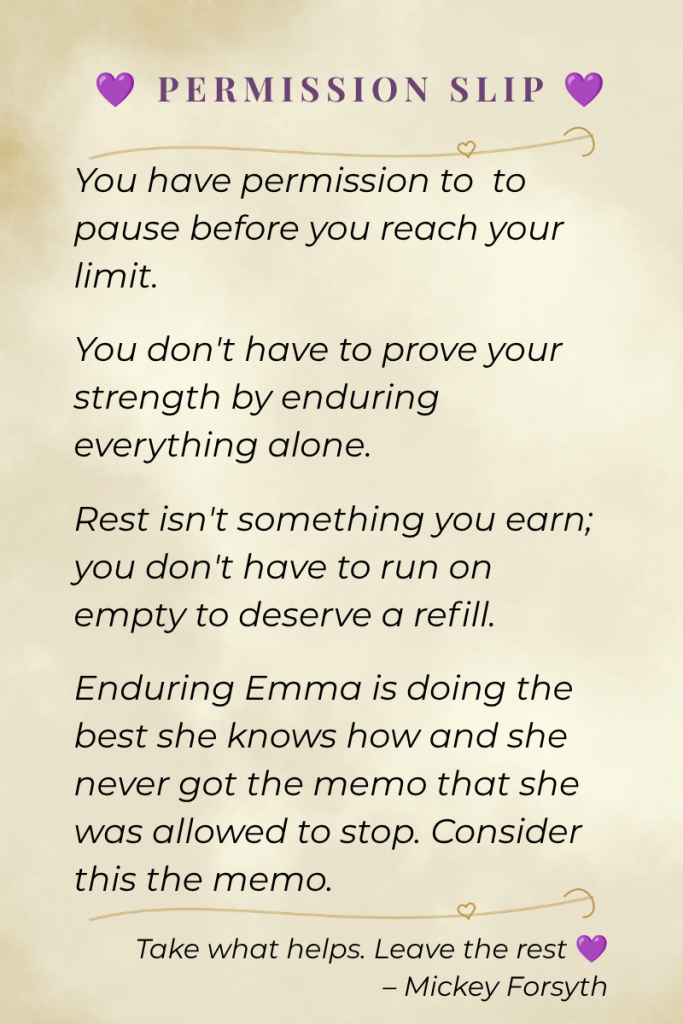
Take what helps. Leave the rest 💜